World Aids Day is held on December 1st around the world and has been since it's creation in 1988 by UNAIDS.
I feel like I am uninformed about a lot of the AIDS organizational history, so here is just a little background in honor of this week's important day.
The first defined cases of AIDS were documented on June 5th, 1981, and was reported as 5 young gay men with Pneumocystis Pneumonia Carinii (PCP), this infection is only found on individuals with seriously complicated immune systems, cytomegalovirus, and disseminated candida infections (avert.org). And by the end of 1981, every week 6 new cases were being reported of this unknown, undefinable disease.
The Acronym AIDS (Acquired Immune Deficiency Syndrome) was recognized starting in Fall 1982.
In too many years afterwards (til approximately 1984), no one in the public was sure how the disease was transmitted and thus many stigmas and discrimination came out of the unknowing.
Finally in 1984, the CDC reported that French researches mad possibly located the virus that causes AIDS “We cannot know for sure now that the LAV virus is the agent that causes AIDS, but the pattern it follows in the human body makes us believe it is” (avert.org).
March 1985 was the month in which there was a test ready to test for AIDS in one's system, and later on in 1986 the government through Surgeon General's Reports and the CDC began to encourage safe sex and condom use as opposed to simply banning HIV positive immigrants- education was starting to decrease the discrimination.
The first drug treatment for AIDS was created in AZT, the first antiretroviral drug, and approved by the FDA in 1987.
In 2009, 33.3 million people worldwide were estimated to be living with AIDS, 15.9 of them being children, with 2.6 million people being newly infected each year.
Even though we are very far away from learning all we can about AIDS, the world is finally begun to stabilize this epidemic and the new infection and death toll numbers have steadily declined.
Tuesday, November 29, 2011
Monday, November 28, 2011
Che Guevara
Guervara was borin in 1928 to a fairly well off family in Argentina. The son of doctor Guevara had a good education and could have easily lived out the rest of his life in relative peace and quite. Guevara eventually began to fight against the many social injustices he saw in the world of South America. He earned the nickname Che during the Cuban revolution during which he became famous. Che was known by his enemies and friends to be an idealist. He often stood for hardwork, equality, the people and bravery. In fact there was one thing Che could never tolearte and it was cowardice. Che would have deserters shot on sit for leaving the army. Che was also known as one of the most inteligent officers in the Cuban military. The man also was one who would not step down this turned against him when he refused to accept the Soviet Union as Cuba's ally. Instead he turned his focus to fighting injustice in the world he fought a revolution in Africa and eventually went to Bolivia to gain support from the Bolivian peasnats. The peasants however turned him in and he was executed, the weird thing is that he never said a bad word about those who turned them in. The picture that became his symbol was taken in 1968 and gained great fame when it became the symbol of rebellious French students. His picture even today continues to incite the feelings of rebellion in todays youth.
Sunday, November 27, 2011
Was Jesus white?
One of the most important religious symbols is the image of Jesus Christ. I have often wondered why he is usually portrayed as white when he was born in the middle east and therefore one would think he would look more middle eastern. In my research I found that it was not known exactly what ethnicity Jesus was because the Bible doesn't include any clear physical description of him. The most common images of Jesus as white or sometimes as African come from cultural stereotypes that have been passed down through generations.
I think that the race of Jesus is a really interesting topic because it illustrates the way we create images and stereotypes based heavily on our own cultural norms.
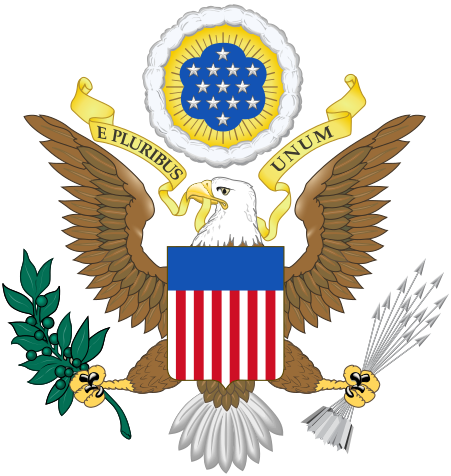
The Great Seal
The Great Seal of the United States is a famous symbol of the U.S. dating back to 1782. It shows the coat of arms of the United States. Pictured is a shield, similar to the American flag, though different. An eagle with it's wings out-stretched holds 13 arrows on his right and an olive branch (traditionally with 13 leaves, though not required legally) on his left. His head is turned towards the olive branch, show the United States prefers peace but is ready for war. The eagle also holds a scroll with the moto, "E Pluribus Unum." Above the eagle is a "glory" with 13 stars.
The Olympic Mascot of Londontown 2012
As I was wandering London this weekend I couldn't help but notice the excitement surrounding the upcoming 2012 Olympics that London is hosting. Also I had to notice the very strange mascot shown here:
http://i.dailymail.co.uk/i/pix/2010/05/20/article-1279736-09A7FFEB000005DC-301_634x429.jpg
Wenlock and Mandeville are their names and they are said to be "created from drops of steel from the new Olympic stadium".
Wenlock is named after the Shropshire town of Much Wenlock where in the mid 19th century the Wenlock Games because the inspiration for modern day Olympics. Mandeville after the Stoke Mandeville hospital where Dr. Mandeville practiced- a forerunner for Paralympics.
The creative agency, Iris, designed these mascots. Highly controversial for their strange looks, these two mascots are said to be designed in a way that inspires children to exercise. A little of their breakdown is shown in this picture:
http://i.dailymail.co.uk/i/pix/2010/05/19/article-1279736-09A7F9E8000005DC-924_634x366.jpg
Ski Trail Ratings

The above are the basic ski trail symbols that are used in the US and Australia/New Zealand. They're created to give tourists and developing skiers guidance as to the safest and most ability appropriate way down the mountain.
In Europe and Asia, similar colors are used but shapes and rarely used. Always, easy is represented by green. I think this is because green is most commonly known as a "cool" color. I think the same goes for blue. As for the shape, I think a circle was used because it has no harsh angles or corners and is just smooth. I think black diamonds represent more challenging trails because diamonds are a lesser-used shape and black is the least friendly of the colors.
These symbols become erroneous to locals after some time, but they undoubtedly keep beginner and intermediate skiers safe.
Wednesday, November 23, 2011
Britain cuts Iran's funding
Monday Briatin cut off Iran from the entire british financial sector. This is the first time britain has banned an entire financial sector from the British treasury. The cut off came from an increasing threat of the Iranian nuclear sector. The alaram came from the International Atomic Energy Agency reported the possible 'military dimensions' of the Iranian Atomic program. The Iranian claimed the reports were false and were politically motivated. The US has placed sanction on Iranian blanks along with many money laundering concrens but they have not completely cut all financial ties with the Iranian bank. The US has however prohibited buisness with all Iranian buissness'. The British have also announced that similar announcements will be made by partner states leaving Iran with very little funding in the global community.
http://edition.cnn.com/2011/11/21/world/europe/uk-iran-sanctions/index.html?hpt=ieu_c2
1.Could pulling the plug on an already desperate country make problems worse?
2. What result will this have on the civilians of Iran and the country's overall infrastructure
http://edition.cnn.com/2011/11/21/world/europe/uk-iran-sanctions/index.html?hpt=ieu_c2
1.Could pulling the plug on an already desperate country make problems worse?
2. What result will this have on the civilians of Iran and the country's overall infrastructure
Subscribe to:
Posts (Atom)